This is a repost of a thread from last month which I thought would be constructive to reproduce in full. Despite the answer probably seeming obvious to a casual outsider, there’s actually a prevailing belief that the 18th century British military was so archaic, and flintlock muskets were so inaccurate, that they never bothered to teach their soldiers to aim their weapons, let alone accurately.
British soldiers in the 18th century aimed at people. The British Army in the 18th century deliberately taught its soldiers to aim at people. The idea that all soldiers pointed the terribly inaccurate muskets in the vague direction of the enemy and cringed away from the pan flash is a Hollywood myth.
Rapid firing and the oft-repeated “three rounds a minute” has been mentioned. It was not, in fact, the British who were the main proponents of quick musketry in the late 18th century, but rather the Prussians. After the Seven Years War a “quick firing craze” gripped Prussia’s military establishment, and their entire drill became focussed on how quickly bodies of troops could lay down fire. The King of Prussia wrote in 1768 that ‘A force of infantry that loads speedily will always get the better of a force which loads more slowly.” One Prussian regiment during a drill were even able to once get off six shots in a minute.
The British Army were aware of this Prussian style, and many officers did believe that reloading quickly was a key military skill. They also, however, believed in accuracy. Some quotes;
Dr. Robert Jackson, assistant surgeon to the 71st Highlanders during the American Revolution: ‘The firelock is an instrument of missile force. It is obvious that the… missile ought to be directed by aim, otherwise it will strike only by accident.’
Major General the Earl of Cavan: ‘have at have the breech [of the firelock] a small sight-channel made, for the advantage and convenience of occasionally taking better aim.’
Lieutenant General Gage, writing about the training of new recruits three days before the battle of Bunker Hill: ‘Proper marksmen are to instruct them in taking aim, and the position in which they ought to stand in firing, and to do this man by man before they are suffered to fire together.’
Gage again: ‘The men [should] be taught to take good aim, which if they do they will always level well.’
Even more important than these clear directives, the Army’s actual drill book, the 1764 Regulations gave instructions for aiming, and stated that when firing a musket:
“the right Cheek to be close to the Butt, and the left Eye shut, and look along the Barrel with the right Eye from the Breech Pin to the Muzzel.”
As per the Earl Cavan’s advice, British soldiers actually customised their muskets to help with aiming by chiseling a groove into the breech of their muskets that they could then line up with the bayonet lug pin at the tip of the barrel. There are ‘many surviving, regimentally-marked muskets (that is, weapons that we know left the armories and were used in the field) have a neat groove filed into the top of the breech for sighting along the barrel.’ Example schematic below;
Nor are we only relying on the instructions of officers and manuals to know that British soldiers actually aimed. During war times ‘troops spent a god deal of time shooting ball when they were not in the field. In America, shooting at marks was a common element of the feverish training that preceded the opening of each campaign season; indeed, it occurred almost on a daily basis.’ [Matthew H. Spring, With Zeal and With Bayonets Only, p. 207] In Boston in January, 1775, a British officer wrote about accuracy drills being undertaken;
“The Regiments are frequently practiced at firing ball at marks. Six rounds pr man at each time is usually allotted for this practice. As our Regiment is quartered on a Wharf which Projects into the harbour, and there is very considerable range without any obstruction, we have fixed figures of men as large as life, made of thin boards, on small stages, which are anchored at a proper distance from the end of the Wharf, at which the men fire. Objects afloat, which move up and down with the tide, are frequently pointed out for them to fire at, and Premiums are sometimes given for the best shots, by which means some of our men have become excellent marksmen.”
Another visitor to Boston in 1775 wrote that;
I saw a regiment and the body of Marines, each by itself, firing at marks. A target being set up before each company, the soldiers of the regiment stepped out singly, took aim and fired, and the firing was kept up in this manner by the whole regiment until they had all fired ten rounds. The Marines fired by platoons, by companies, and sometimes by files, and made some general discharges, taking aim all the while at targets.’
Some pointers on other things mentions;
There’s little indication that widespread targeting of officers as deliberate policy by Whigs troops. There are certainly instance of men shooting, even being directed to shoot, at officers… on both sides. British light infantrymen, some of whom were rifle-armed, were known to shoot Whig officers as well. People have always targeted officers – during the English Civil War a Parliamentarian commander, Lord Brooke was sniped by a Royalist soldier hiding in a bell tower in Lichfield. Ultimately the British Army did not suffer notably higher casualty ratios among its officers in the American Revolutionary War compared to any other contemporary conflicts. A minority of Whigs used rifles – only a handful in the Continental Army regiments and probably only about half of the militia. Most used the exact same muskets as the British. Most British officers didn’t ride horses – of a battalion’s thirty-or-so officers only about three would be mounted. Nor did officers flounce around in gold lace and plumed hats – most modified their uniforms to account for the difficulties of combat, as shown by various contemporary portraits.
Describing Whig tactics as guerilla warfare is also stretching the facts – the concept of “guerilla” first began with the Spanish in Peninsula War in 1808, and Whig efforts paled in comparison. Native Americans did teach a style of irregular warfare, but they taught it mostly to the British Army in the Seven Years War, who then implemented light infantry tactics to account for the difficulty of waging war in the North American wilderness. Throughout the Revolutionary War Native American tribes and American Loyalists conducted a highly successful irregular campaign across the frontier, overseen by a few British officers of the government’s Indian Department.
The jury remains out among academics as to how decisive partisan fighting was to the Revolutionary War. It was certainly a game changer in battles like Saratoga, but equally it was frequently discouraged by high-ranking Whig officers (like Washington) who knew that if their new nation were to appear legitimate in the eyes of others they needed a professional standing army who fought in the regular manner. That, ultimately, is how the Whigs won the war – by the end the Continental Army’s regulars out-regulared the British in line warfare. In most pitched battles the militia were just window dressing.
tl;dr the Americans were amazing because they became better regular soldiers than the British, and the British conquered 97% of the world because, believe it or not, they told their soldiers to aim their guns at the enemy. The “dumb Brits standing in lines shooting away at nothing while being sniped at by plucky homespun farmers” does a disservice to the courage and abilities of American soldiers during the Revolution and has been thoroughly slaughtered in academia over the past decade.
Interesting….but a book I read some years ago said the “Brown Bess” and other muskets were SO inaccurate that the manuals at the time called for troops to stand IN A LINE (which they CLEARLY DID !) and hold the muskets AT WAIST level….and they might ACTUALLY hit something….only the American “rifled barrel” “Pennsylvania rifles” and “Kentucky rifles” could you actually hit something you aimed at…
That’s… just not true?
A book I read (British author) said it WAS (true) and even quoted from a British Army Manual of Arms from the period, so it is “dueling manuals” if you have one that says otherwise….I would have to research the book if I can even find it anymore to cite it properly…
I almost blowed myself up firing smokeless powder out of a muzzleloader and now I am an expert in 18th century warfare! See here is some book I read a long time ago by a (British author) and he says it’s all true!
@codylance, You should actually read the British Manual of Arms, it was also written by a British Author. There is a free online copy available on archive.org
First off, recognize that despite what may seem like common knowledge, these big line infantry battles were not just lines of infantry facing one another and trading volleys of fire. That’s actually what utter incompetence, or a gross simplification would be. Battalions (or units, whatever) would be maneuvering, attempting to find position, artillery would be shelling the lines, and cavalry would be dashing about like a pack of prancing douchebags looking for weaknesses in the lines to exploit, flanks to turn, and pigs to attempt to seduce.
The mass lines are a result of this. At the time, it was pretty well known that artillery caused an awful lot of casualties, and cavalry would turn a withdrawal into a rout. Infantry was sort of stuck in the middle, much like the last pig with two cavalrymen. Much of infantry tactics and equipment reflected this. For example, muskets were so long in order to be able to mount a bayonet to fend off a cavalry charge with traditional pike tactics. With that said, cavalry would harry advancing lines of infantry to keep them in the kill zone for artillery, while the artillery would prevent the infantry from forming square to neutralize cavalry. Yaaaaay tactical rock paper scissors. Except everything hates infantry.
The other major reason is that battles are won by morale. Morale is weakened by shock. Losing ten men out of a hundred man formation is less frightening when they drop with a minute or two between them versus all ten dropping at once. This is why battalions would fire generally all at once, or in those by-line, by-platoon, or by-whatever rippling volleys. It was known that coordinating these volleys actually slowed the total rate of fire because the fastest reloaders would have to wait for the slowest. However, this meant that the volleys all hit at once, creating a shock on the target unit, hopefully causing them to falter, withdraw, or rout. It was discovered that the best way to produce a single volley was a line abreast two to four deep. So they went with it.
At the same time, these muskets weren’t exactly the most accurate. Part of this was because they were in fact smoothbore, and so the ball wasn’t exactly stable. The balls were also a little inconsistent- shot towers wouldn’t be developed until 1780 something, so they were mold-cast. Secondly, black powder was, in fact, fucking filthy. Balls were often subcaliber so they could still be loaded once the barrel was fouled. But that said, they were still accurate enough to hit a human sized target at one to two hundred yards with a little bit of time and effort to aim. At the time, the standard infantry target was a strip of cloth about three feet top to bottom, about three feet off the ground, and about as wide as the firing element. Units would consistently train volley fire shooting at this, and were also consistently hitting it.
Finally, the muskets had shoulder stocks. They had a shoulder stock. A stock, that you put in your shoulder. It’s carved to fit a human shoulder. Not a fucking waist. Just. It’s made to go to your shoulder. Why would you hold it by your waist? Why?
This isn’t even getting into the psychology of bayonet charges, and why Continental Army units standing their ground in the face of them was a huge turning point in the Revolution. That’s where you’d hold a musket at waist level, though. It evolved from the prior above shoulder height pike-based bayonet charge position.
Finally, just because you can’t do something, don’t assume that it couldn’t be done. Especially with guns.
This is a repost of a thread from last month which I thought would be constructive to reproduce in full. Despite the answer probably seeming obvious to a casual outsider, there’s actually a prevailing belief that the 18th century British military was so archaic, and flintlock muskets were so inaccurate, that they never bothered to teach their soldiers to aim their weapons, let alone accurately.
British soldiers in the 18th century aimed at people. The British Army in the 18th century deliberately taught its soldiers to aim at people. The idea that all soldiers pointed the terribly inaccurate muskets in the vague direction of the enemy and cringed away from the pan flash is a Hollywood myth.
Rapid firing and the oft-repeated “three rounds a minute” has been mentioned. It was not, in fact, the British who were the main proponents of quick musketry in the late 18th century, but rather the Prussians. After the Seven Years War a “quick firing craze” gripped Prussia’s military establishment, and their entire drill became focussed on how quickly bodies of troops could lay down fire. The King of Prussia wrote in 1768 that ‘A force of infantry that loads speedily will always get the better of a force which loads more slowly.” One Prussian regiment during a drill were even able to once get off six shots in a minute.
The British Army were aware of this Prussian style, and many officers did believe that reloading quickly was a key military skill. They also, however, believed in accuracy. Some quotes;
Dr. Robert Jackson, assistant surgeon to the 71st Highlanders during the American Revolution: ‘The firelock is an instrument of missile force. It is obvious that the… missile ought to be directed by aim, otherwise it will strike only by accident.’
Major General the Earl of Cavan: ‘have at have the breech [of the firelock] a small sight-channel made, for the advantage and convenience of occasionally taking better aim.’
Lieutenant General Gage, writing about the training of new recruits three days before the battle of Bunker Hill: ‘Proper marksmen are to instruct them in taking aim, and the position in which they ought to stand in firing, and to do this man by man before they are suffered to fire together.’
Gage again: ‘The men [should] be taught to take good aim, which if they do they will always level well.’
Even more important than these clear directives, the Army’s actual drill book, the 1764 Regulations gave instructions for aiming, and stated that when firing a musket:
“the right Cheek to be close to the Butt, and the left Eye shut, and look along the Barrel with the right Eye from the Breech Pin to the Muzzel.”
As per the Earl Cavan’s advice, British soldiers actually customised their muskets to help with aiming by chiseling a groove into the breech of their muskets that they could then line up with the bayonet lug pin at the tip of the barrel. There are ‘many surviving, regimentally-marked muskets (that is, weapons that we know left the armories and were used in the field) have a neat groove filed into the top of the breech for sighting along the barrel.’ Example schematic below;
Nor are we only relying on the instructions of officers and manuals to know that British soldiers actually aimed. During war times ‘troops spent a god deal of time shooting ball when they were not in the field. In America, shooting at marks was a common element of the feverish training that preceded the opening of each campaign season; indeed, it occurred almost on a daily basis.’ [Matthew H. Spring, With Zeal and With Bayonets Only, p. 207] In Boston in January, 1775, a British officer wrote about accuracy drills being undertaken;
“The Regiments are frequently practiced at firing ball at marks. Six rounds pr man at each time is usually allotted for this practice. As our Regiment is quartered on a Wharf which Projects into the harbour, and there is very considerable range without any obstruction, we have fixed figures of men as large as life, made of thin boards, on small stages, which are anchored at a proper distance from the end of the Wharf, at which the men fire. Objects afloat, which move up and down with the tide, are frequently pointed out for them to fire at, and Premiums are sometimes given for the best shots, by which means some of our men have become excellent marksmen.”
Another visitor to Boston in 1775 wrote that;
I saw a regiment and the body of Marines, each by itself, firing at marks. A target being set up before each company, the soldiers of the regiment stepped out singly, took aim and fired, and the firing was kept up in this manner by the whole regiment until they had all fired ten rounds. The Marines fired by platoons, by companies, and sometimes by files, and made some general discharges, taking aim all the while at targets.’
Some pointers on other things mentions;
There’s little indication that widespread targeting of officers as deliberate policy by Whigs troops. There are certainly instance of men shooting, even being directed to shoot, at officers… on both sides. British light infantrymen, some of whom were rifle-armed, were known to shoot Whig officers as well. People have always targeted officers – during the English Civil War a Parliamentarian commander, Lord Brooke was sniped by a Royalist soldier hiding in a bell tower in Lichfield. Ultimately the British Army did not suffer notably higher casualty ratios among its officers in the American Revolutionary War compared to any other contemporary conflicts. A minority of Whigs used rifles – only a handful in the Continental Army regiments and probably only about half of the militia. Most used the exact same muskets as the British. Most British officers didn’t ride horses – of a battalion’s thirty-or-so officers only about three would be mounted. Nor did officers flounce around in gold lace and plumed hats – most modified their uniforms to account for the difficulties of combat, as shown by various contemporary portraits.
Describing Whig tactics as guerilla warfare is also stretching the facts – the concept of “guerilla” first began with the Spanish in Peninsula War in 1808, and Whig efforts paled in comparison. Native Americans did teach a style of irregular warfare, but they taught it mostly to the British Army in the Seven Years War, who then implemented light infantry tactics to account for the difficulty of waging war in the North American wilderness. Throughout the Revolutionary War Native American tribes and American Loyalists conducted a highly successful irregular campaign across the frontier, overseen by a few British officers of the government’s Indian Department.
The jury remains out among academics as to how decisive partisan fighting was to the Revolutionary War. It was certainly a game changer in battles like Saratoga, but equally it was frequently discouraged by high-ranking Whig officers (like Washington) who knew that if their new nation were to appear legitimate in the eyes of others they needed a professional standing army who fought in the regular manner. That, ultimately, is how the Whigs won the war – by the end the Continental Army’s regulars out-regulared the British in line warfare. In most pitched battles the militia were just window dressing.
tl;dr the Americans were amazing because they became better regular soldiers than the British, and the British conquered 97% of the world because, believe it or not, they told their soldiers to aim their guns at the enemy. The “dumb Brits standing in lines shooting away at nothing while being sniped at by plucky homespun farmers” does a disservice to the courage and abilities of American soldiers during the Revolution and has been thoroughly slaughtered in academia over the past decade.
Interesting….but a book I read some years ago said the “Brown Bess” and other muskets were SO inaccurate that the manuals at the time called for troops to stand IN A LINE (which they CLEARLY DID !) and hold the muskets AT WAIST level….and they might ACTUALLY hit something….only the American “rifled barrel” “Pennsylvania rifles” and “Kentucky rifles” could you actually hit something you aimed at…
That’s… just not true?
A book I read (British author) said it WAS (true) and even quoted from a British Army Manual of Arms from the period, so it is “dueling manuals” if you have one that says otherwise….I would have to research the book if I can even find it anymore to cite it properly…
I almost blowed myself up firing smokeless powder out of a muzzleloader and now I am an expert in 18th century warfare! See here is some book I read a long time ago by a (British author) and he says it’s all true!
@codylance, You should actually read the British Manual of Arms, it was also written by a British Author. There is a free online copy available on archive.org
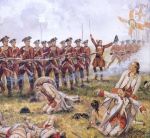
French forces are repulsed by British infantry at the battle of the Plains of Abraham, 1759.
Note British muskets are held at waist level & not “aimed”… 🙂
That’s at the “charge bayonets” position after firing the volley and before beginning to advance.
Well, it doesn’t help if one “aims” as with a modern (or even a contemporaneous) rifle because the ball flies in various directions if no rifled barrel……That’s just science ! Better to line up with many abreast (as in the photo) and point in the general direction at waist level. Then you might accidentally HIT something (with that many firing).!! Plus, without modern “smokeless” powder, why risk burning your face by holding ithe piece up “against your cheek” when THE INSTRUMENT CANNOT BE FIRED WITH ANY ACCURACY within 20 feet..!!! ….Tell me: why did armies line up many abreast (with bright red coats no less!) IF SOMEONE COULD ACTUALLY SOMEWHAT “AIM” and pick them off..?!?? Not saying some didn’t try to aim, but it was a fool’s errand if they did….If you ever fired a modern replica of a “Brown Bess” – as I have – you would know this. Even with modern “smokeless” powder (WAY better than what THEY had) three of us fired at a very wide tree stump from about 30 feet – two aiming, modern style (or as depicted by Hollywood) and me pointing at waist level as a book I had recently read said REALLY happened – and NONE of us EVER hit the stump….not once in an entire afternoon of trying…!!! I suggest your research is flawed…
Astonishing stuff.
I read up to the point where he says they fired smokeless powder out their musket, then I could no longer take anything he is saying seriously.
frankly speaking i think kids doing the fortnite dances at any given opportunity in public is genuinely hilarious and im glad they’re having a good time anyone who complains because someone is enjoying themself in a completely harmless way like that and not inconveniencing anyone just hates fun
















 Tumblr refugee